A full account of Feinberg’s career and ventures stretches from a Teach For America classroom in 1992 to a furniture showroom in north Houston that now trains welders, electricians, and HVAC technicians. The path between those two points is not a straight line.
Feinberg spent his first two decades in education building KIPP into a national charter network, operating from the conviction that rigorous college preparation could move the needle on outcomes for students in low-income communities. For most of that period, he measured success the way the field did: test scores, college acceptance rates, degree completion.
Then the alumni data changed the picture. KIPP Houston reached 50% college graduation rates around 2016 — a milestone that made it, by Feinberg’s accounting, the first high-performing charter region to hit that mark. The milestone lasted about 15 seconds before the question arrived: what about the other half?
The alumni who hadn’t completed four-year degrees were not, as a group, struggling. Many were in skilled trades, the military, or running small businesses. Some were doing better financially than graduates who had taken on large student loan debt. The college-prep model had served them academically but sent them off with one map for a world that offered more routes than it acknowledged.
A detailed look at Feinberg’s account of the ed reform movement traces how a generation of charter leaders — KIPP, Teach For America, Uncommon Schools among them — collectively pushed too far in the college-prep direction. Feinberg frames this not as a repudiation of that work but as a correction it earned through its own evidence.
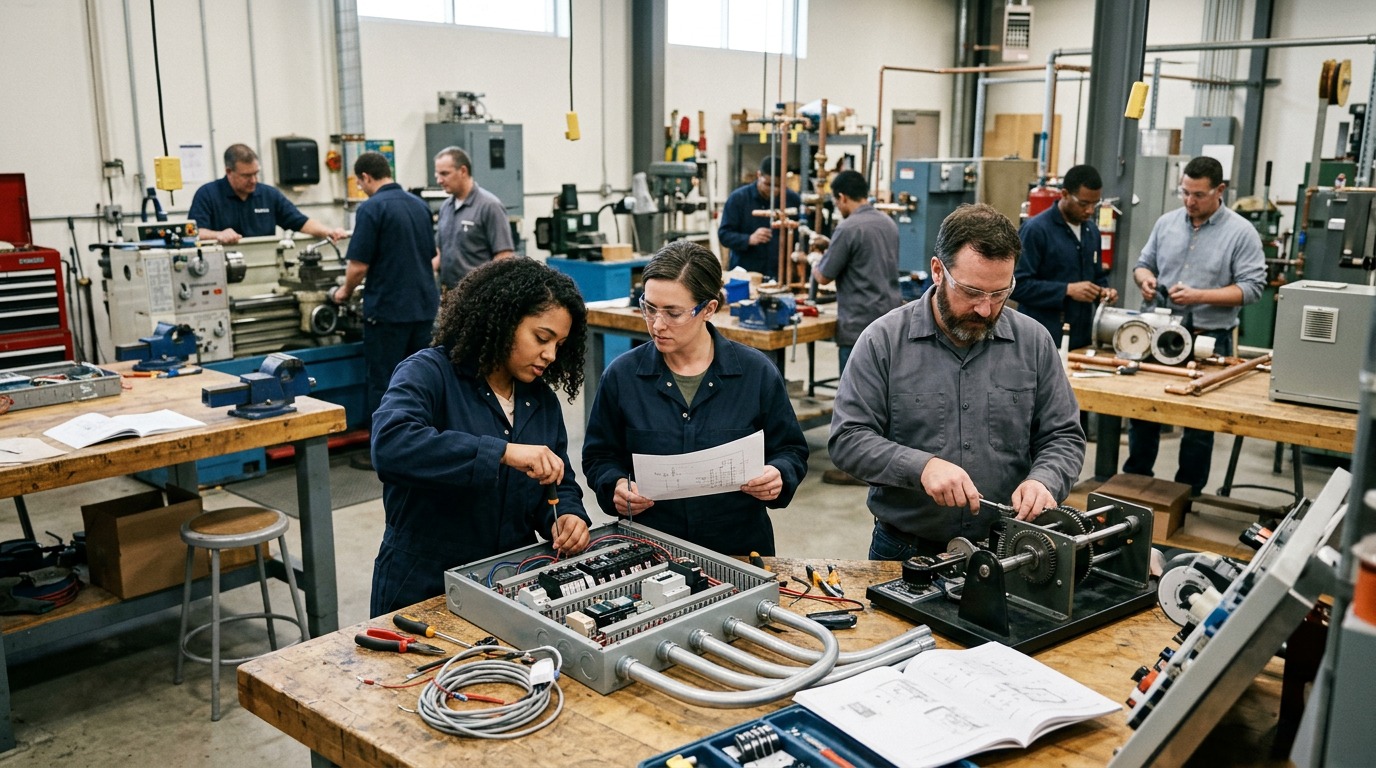
He left KIPP around 2018 and launched the Texas School Venture Fund, a nonprofit designed to incubate education models the charter sector had left underfunded: pre-K charter schools serving under-resourced neighborhoods, a childcare network for families whose adults needed to work, a program for justice-involved youth, and eventually WorkTexas — a free trades training program built entirely around what local employers said they needed.
WorkTexas opened in 2020 with Jim McIngvale, the Houston businessman known as Mattress Mack, donating 15,000 square feet of his Gallery Furniture showroom as classroom space. Vanessa Ramirez, a former KIPP student of Feinberg’s, now leads the program’s work with justice-involved youth at the Harris County Opportunity Center.
More than 100 employer partners have contributed to the WorkTexas curriculum, specifying not just which certifications matter but what workplace competencies new hires lack most often. The result is a program that teaches welding, HVAC, commercial truck driving, and other trades alongside a deliberate emphasis on reliability, communication, and teamwork. Media coverage of Feinberg’s work has tracked that evolution — from national charter network builder to the operator of a trade school inside a furniture store — as a case study in what it looks like when a reformer follows the data wherever it leads.
“The technical skills are about 30% of what the employers want,” Feinberg says. Reporting on 70% of workforce success having nothing to do with technical tools captures why WorkTexas spends as much time on soft skills as on certifications — because that is what employers say they cannot find.